The age of the academic architectis now.
The apex professional body for higher education faculty across Africa. Elevating instructional mastery, research sovereignty, and executive academic leadership.
Centres of Excellence
6 Schools
Qualification Ladder
Levels 7–10
Accreditation Standing
Verified CPD
Continental Academic Fellowship
Apex professional body designated across 54 AU member states for faculty CPD and accreditation.
Harmonising faculty instruction from Postgraduate Certificate (Level 7) to Executive Fellowship (Level 10).
Decolonial research ethics and indigenous African methodological paradigms rooted in Ubuntu philosophy.
A unified academy forfifty-four sovereign nations
Higher education in Africa has historically endured structural fragmentation across colonial language zones. The College for Advancement of Academics builds an interconnected continental infrastructure — uniting faculty, national quality agencies, and research consortia under a single sovereign benchmark.
We believe that African universities must not merely consume knowledge produced in other hemispheres — they must be the primary producers of cutting-edge research, transformative pedagogies, and ethical governance paradigms that lead the world.
Through accredited continuous professional development, independent mock accreditation, and sovereign peer-review registers, the College ensures that every academic holds verified credentials recognized across the continent and throughout the global diaspora.
“Our mandate is simple: ensure that Africa's finest academic minds receive continental recognition, sovereign resources, and global influence.”
— From the Founding Charter of the CollegeInstitutional Sovereignty
Ending structural reliance on external certification bodies by delivering rigorous, context-aware continental quality auditing.
Borderless Scholarly Mobility
Enabling bilateral faculty exchange, joint research appointments, and pan-African external examiner accreditation.
Epistemic Decolonization
Embedding authentic indigenous philosophies and African methodological canons directly into university curricula.
College for Advancement of Academics Network
Pan-African reach across our specialised schools and centres of excellence, verified CPD credit pathways, and regional academic focus areas.
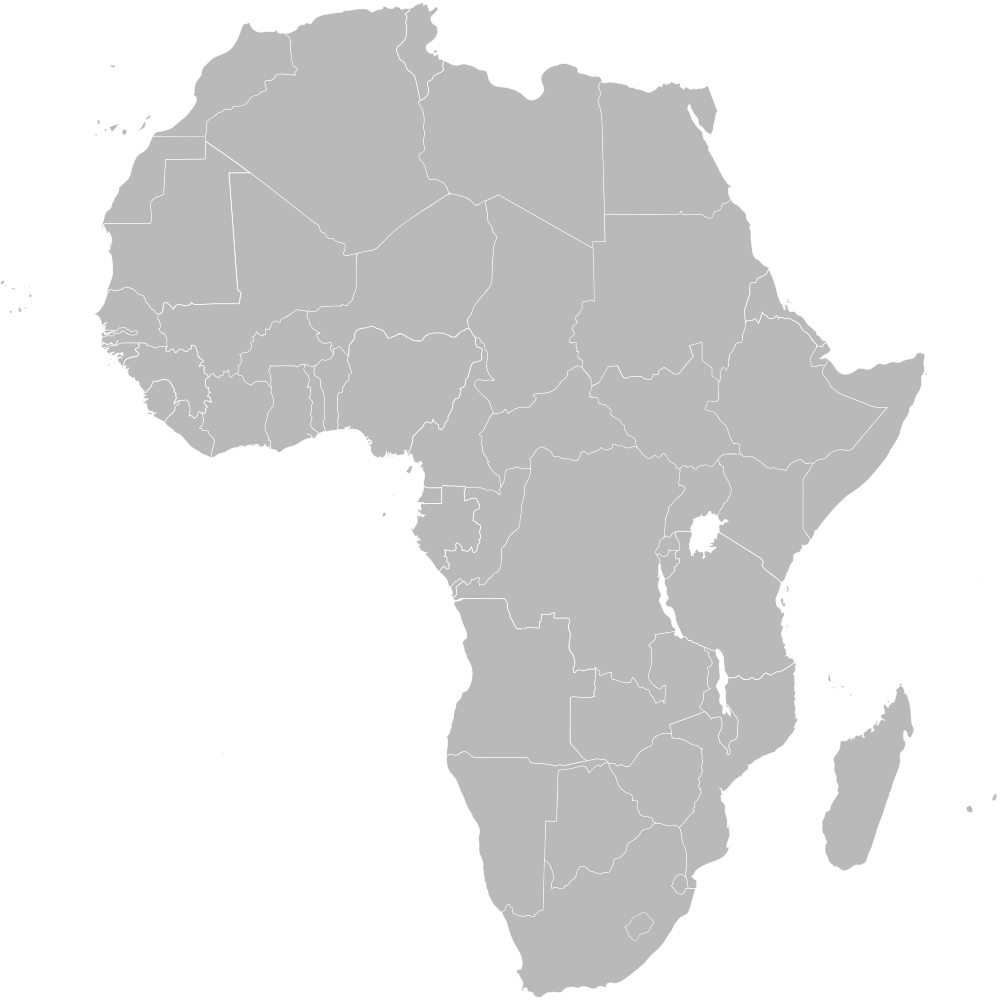
Pan-African Overview
A unified academic network bridging higher education faculties across 54 sovereign African nations. All six specialised schools and centres of excellence operate collaboratively across the continent.
The CAA Continental Framework
Elevating higher education across Africa through verified qualifications, continuous professional development, and research leadership.
African Union member states with verified faculty representation.
Postgraduate qualification framework from Diploma to Executive Fellowship.
Accredited CPD credit tracking with instant tamper-proof verification.
Specialised Schools & Pathways
Six specialised institutions providing structured CPD modules, accredited qualifications, and institutional transformation.
Centre for Africanization of Knowledge & Institutional Transformation
Offers integrated programs combining African epistemologies, decolonization theory, and institutional transformation
Centre for Agenda 2063 & Continental Transformation
General Academy & Orientation
School of Leadership, Mentorship & Professional Development
School of Research & Knowledge Innovation
School of Teaching Excellence & Curriculum Development
Curriculum Scope
8 Accredited Courses
Academic Tier
Institutional Transformation Suite
Accreditation Status
Verified Standing
African Epistemologies and Knowledge Systems
African Research Methodologies
African Values, Ethics, and Educational Leadership
Curriculum Transformation and Cultural Relevance
Decolonization of Higher Education
Decolonizing the Curriculum: African Epistemologies in Practice
Institutional Innovation and Reform Strategies
Pan-Africanism, Globalization, and the Future of African Universities
The six pillars ofacademic sovereignty
CAA elevates faculty capacity across six interconnected domains of scholarly practice — transforming individual careers and institutional performance.
Teaching Excellence
Move beyond lecturing to Distinguished Pedagogue: high-impact instruction, digital pedagogies, and innovative curriculum design.
Research Innovation
Secure competitive global grants and establish a verifiable track record of sovereign, high-impact scholarly publishing.
Academic Leadership
Transition from departmental oversight to Strategic Architect: prepared for Deanship, Vice-Chancellor, and executive governance roles.
Mentorship & Network
Join the Pan-African Scholarly Network: peer review consortiums, cross-border research clusters, and senior mentorship.
Knowledge Transformation
Champion epistemic sovereignty and curriculum Africanization: rooting academic syllabi in continental realities with global relevance.
Institutional Assurance
Equip universities with mock accreditation, peer review benchmarks, and continuous professional development audits.
Beyond Ubuntu:
Africa's Continental Relational Ethics
Africa is home to more than 2,000 living languages. While Ubuntu (Nguni) has gained global renown, it is one branch of a universal continental philosophy. Across every linguistic family, African societies formulated an indigenous ethics of personhood: “A person is a person through other persons.” Explore representative traditions across all 7 regions below.
Ubuntu
“Umuntu ngumuntu ngabantu”
“A person is a person through other persons”
Human personhood is a relational accomplishment, not an isolated state — earned through reciprocity, compassion, and shared dignity. Scholars distinguish two readings: the communitarian (community constitutes the person; Ramose, Mbiti) and the humanist (relational flourishing that does not erase individual agency; Metz, Gyekye). Both agree that Ubuntu grounds ethical obligation in the concrete bonds between people, not abstract rights.
Collaborative research consortiums, restorative peer review, decolonized epistemology, and collective scholarship over hyper-individualistic academic competition.
The Voice of African Scholarship
“Umuntu ngumuntu ngabantu — a person is a person through other persons. In African academia, we rise only when we lift each other.”
Listen to Ubuntu, our flagship Pan-African choral song celebrating continental solidarity, intellectual stewardship, and shared purpose across 54 nations. CAA dedicates this song to all academics in Africa and beyond.
Structured tiers forcontinental faculty
From postgraduate researchers to senior academic architects: verified professional post-nominals aligned with levels 7 through 10.
Student Member
The Future AcademicPostgraduate scholars and doctoral candidates preparing for higher education faculty careers.
Associate Member
The Rising ScholarNew entrants, early-career lecturers, and graduate teaching assistants.
Full Member
The Established AcademicActive academics with established university teaching and peer-reviewed research records.
Senior Member
The Master MentorSenior faculty and long-term contributors with verified institutional service and doctoral supervision.
Fellow of the College
Distinguished FellowConferred by Peer Nomination/Application for exceptional, sustained transformation in African scholarship.
Institutional Member
Universities & CollegesAccredited universities, polytechnics, and higher learning centres across all 54 African nations.
Verify Any CAA Credential
All certificates, transcripts, and programme completions issued by the College for Advancement of Academics carry a unique verification code. Check status, validity, and revocation records instantly.
Enter the credential identifier printed on the physical or digital award certificate.
Featured School Courses
Representative foundational and specialist courses across our academic divisions.
African Epistemologies and Knowledge Systems
This foundational, cross-cutting course grounds academics and practitioners in African philosophies of knowledge, ethics, and learning traditions. It equips participants to understand, articulate, and apply Indigenous Knowledge Systems (IKS), Ubuntu ethics, and African philosophical foundations toward epistemic decolonization and the restoration of African knowledge sovereignty in teaching, research, and institutional life.
Academic Freedom, Institutional Integrity & Anti-Corruption
ACT 103 equips Vice-Chancellors, Deans, Heads of Department and senior faculty to defend intellectual freedom, dismantle corruption in university systems, and steward institutional finances transparently. Grounded in the Kampala Declaration tradition and the African Union's Agenda 2063, it converts continental governance instruments into operational codes of conduct, procurement safeguards and whistleblower protocols that leaders can deploy in their own institutions. This course moves beyond abstract governance theory into deployable institutional machinery. Across three modules, participants interrogate the 1990 Kampala Declaration's three pillars, design participatory student–faculty governance and graduated dispute-mediation ladders, run structured procurement red-flag audits, build survivor-centred sexual extortion (sextortion) reporting pathways, and construct transparent grant-accounting and endowment-stewardship systems. The capstone studio synthesises these strands into a complete Institutional Code of Conduct and Anti-Corruption Whistleblower Protocol, complete with retaliation protections and a triage decision tree. Designed for university executive leadership, ACT 103 treats academic freedom, institutional integrity and financial transparency as a single connected system — because in practice, encroachment on autonomy, meritocratic collapse and opaque fund flows reinforce one another. Participants leave with tested instruments they can adopt in their own institutions and defend before councils, regulators and donors.
The Foundation of Professional and Ethical Practice in the Academic Calling
This mandatory gateway course orients every entrant to the College for Advancement of Academics — from aspiring tutor to veteran professor — to the philosophy, ethics, and professional responsibilities of the academic vocation. It establishes a shared moral and professional grounding rooted in the conviction that academia is not merely a career but a calling of service, integrity, and the pursuit of truth within the African higher education landscape. Upon completion, participants earn 16 verified CPD Units and the "Certificate of Foundational Competence in Academic Practice," a non-negotiable precondition for membership confirmation and any level evaluation.
Change Management and Organizational Culture
A practice-focused course for senior academics, heads of department, deans, senate/council members, and academic administrators who must lead institutional change and shape organizational culture. It develops understanding of organizational behaviour in the unique collegial context of higher education, the dynamics of resistance to change, the application of established change-management models (Lewin, Kotter's 8 Steps, ADKAR, McKinsey 7S), and the deliberate shaping of culture for sustainable transformation. Grounded in African institutional realities and CAA's ethos of excellence and transformation, the course equips leaders to drive lasting, contextually grounded change in resource-constrained settings.
Grant Proposal Writing and Funding Acquisition
This practice-intensive course equips African academics, researchers, postgraduate students, and research supervisors with the strategic and technical craft of converting rigorous research designs into fundable proposals. Learners master the full funding lifecycle — from mapping national, continental, and international funders to building theories of change, defensible budgets, equitable partnerships, and compliant submissions — all grounded in the realities and opportunities of African higher education.
Assessment for Learning and Feedback Systems
TEC 107 is a practice-focused, intermediate course that equips teaching faculty, lecturers, and instructors in African higher education to design assessment and feedback that genuinely improves learning. It covers the full assessment craft: the purposes of assessment, assessment of/for/as learning, validity and reliability, constructive alignment of assessment with outcomes, authentic assessment tasks and rubrics, feedback that students actually use, formative feedback systems that work in large classes, self- and peer-assessment, academic integrity, inclusive assessment, and technology-enabled assessment. All content is grounded in the realities of African universities (large cohorts, limited resources, blended and technology-enhanced teaching, and the Africanization agenda) while drawing on the international assessment literature (Biggs, Black & Wiliam, Sadler) reinterpreted for African contexts.
Advance your academic status today
Join Africa's apex professional body for higher education faculty. Enroll in accredited qualifications or apply for institutional university membership.
54 AU NATIONS • CPD CREDIT ACCREDITATION • PERMANENT CONTINENTAL REGISTER